Our world is rapidly adopting AI systems that will co-govern space missions while transforming workplaces from hospitals to classrooms and disaster zones. With the global space economy projected to grow from $630 B in 2023 to $1.8 T by 2035, human–AI system design can no longer be treated as purely technical.
This paper explains how analog astronaut missions integrate Human-by-Design AI governance, creativity, and resource management into space system architecture. What happens in a 14-person Lunar analog habitat in 2020 is a perfect preview of what happens in a 400-person Amazon warehouse, a rural hospital, or a Pacific Island climate-refugee camp in 2026–2032. Isolation → delayed oversight → resource scarcity → life-critical AI delegation → new power dynamics → new social contracts.
Researching the author’s interdisciplinary analog astronaut experiences (2020–2025), such as the Mars Medic Mission at MDRS (Utah), VALORIA II at HI-SEAS (Hawaii), and the World’s Biggest Analog (WBA) (Arizona), we understand the challenges faced by astronauts and the role of crew harmony. Simulation can amplify crew insights, even reciting a small poem e.g., “The prophets really prophecy as mystics, the commentators merely by statistics”, can foster empathy and strengthen crew bonds. Across centuries, from Shakespeare’s sonnets and Nietzsche’s provocations to Einstein’s thought experiments, Bob Dylan’s lyrical philosophy, Leonard Cohen’s timeless poetry, and now modern AI innovations, creativity emerges as a core principle of human experience. Human-by-Design practices such as storytelling, poetry, music, and shared experiences serve as tools for meaningful coexistence and day-to-day operational alignment.
As a result, AI-integrated analog astronaut training serves as a living laboratory for AI governance and workforce transformation, highlighting the role of creativity, ethics, and human meaning in resilient space and Earth systems.
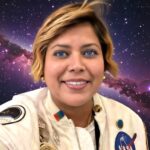 Marufa Bhuiyan, University of Hawai’i at Manoa, US
Marufa Bhuiyan is an educator, analog astronaut, and founder of Everest Innovation Lab in Hawaii. She has served as a Judge for NASA GLOBE Program IVSS and Hawaii Academy of Science since 2020. She holds MS and BS in Biochemistry and Molecular Biology, and is currently a graduate student in the Online Learning and Teaching Program at the University of Hawaii at Manoa.
Marufa has 17+ years of experience in literature reviews, mentoring students and technical research activities. She is a former Research Scholar at the University of Hawaii at Manoa (2013-2017), Visiting Scientist at Tribhuvan University in Nepal, and Secretarial Assistant at the World Health Organization (WHO). She is a co-author for NASA’s decadal survey (2021-2032), speaker for Analog Astronaut Conference, Mars Society Annual International Conventions etc. She is a licensed security professional, ham radio technician (callsign WH6GNE), and an Ambassador for the Mars Society and International Space Station (ISS). She is a former SENCER Hawaii Fellow, Asia Pacific Leadership Program Fellow, and a member of the Hawaiian Astronomical Society. Recently, she got elected as a president for the Asia Pacific Leadership Program Alumni Executive Committee (2026-2028) at the East-West Center. She enjoys reading, writing, traveling, singing at the University Concert Choir and sometimes just having a walk with her dog “Bob Dylan”. For more information, please visit https://www.linkedin.com/in/marufabhuiyan